
AI & Automation in Marketing: Complete Guide to Hyper-Personalization, Content Creation & Campaign Optimization in 2026
Introduction
Marketing has fundamentally changed. Five years ago, a successful campaign meant smart targeting and compelling copy. Today, it requires something far more sophisticated: artificial intelligence orchestrating personalized experiences at scale.
Consider this: The average marketer now spends 40% of their time on repetitive tasks—sending emails, updating segments, adjusting bid strategies, testing subject lines. Meanwhile, customers expect every interaction to feel uniquely tailored to their needs. This is the paradox that AI marketing automation solves.
In 2026, AI-powered marketing isn’t a competitive advantage anymore, it’s table stakes. Companies using machine learning to optimize campaigns report 50% higher conversion rates, while those automating routine tasks free up teams to focus on strategy and creativity. The businesses still managing campaigns manually? They’re falling behind.
This guide walks you through everything you need to know about AI and automation in marketing: the technology behind it, proven use cases, implementation strategies, and tools that actually deliver results. Whether you’re a marketer at a 50-person startup or leading a team at an enterprise, you’ll find actionable insights to transform how your team works.
What is AI Marketing Automation?
AI marketing automation combines two powerful forces:
Marketing Automation: Rules-based workflows that trigger actions (send email, assign lead, update CRM) based on customer behavior Artificial Intelligence: Machine learning algorithms that learn from data, predict outcomes, and optimize decisions in real-time
When combined, they create systems that don’t just execute—they think.
Traditional Automation vs. AI Marketing Automation
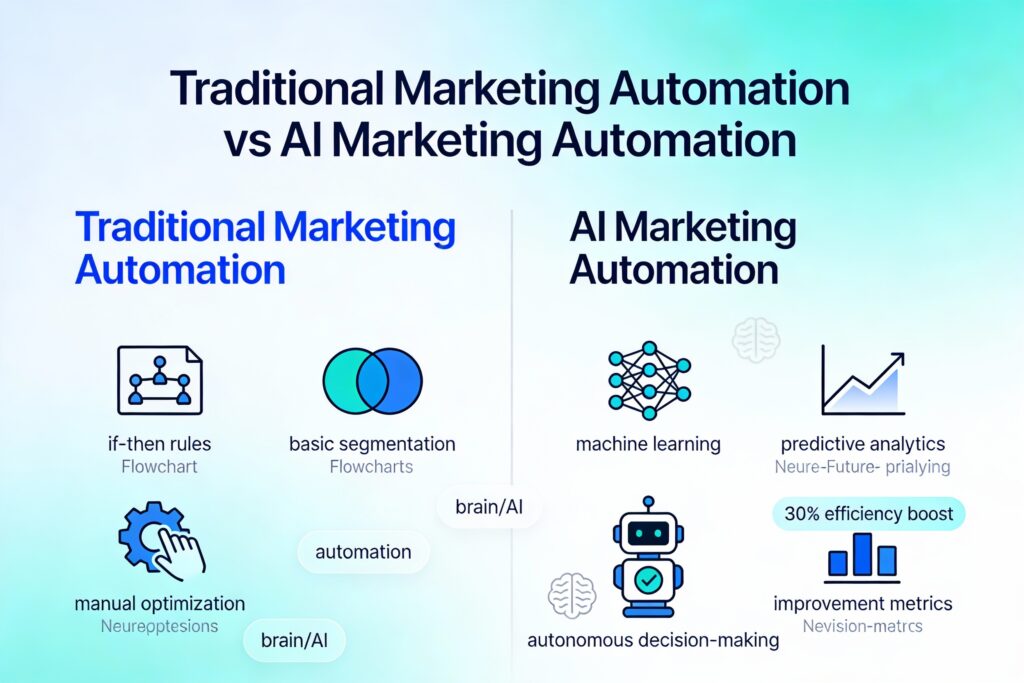
Traditional Marketing Automation:
- If customer opens email → mark as engaged
- If customer clicks link → add to nurture sequence
- If customer visits pricing page → notify sales
AI Marketing Automation:
Predicts which customer will convert, when, and through which channel (without being told)
-
Automatically adjusts email send times based on each individual’s behavior patterns
-
Generates personalized subject lines and content for each recipient
-
Optimizes ad budgets in real-time across campaigns
-
Identifies and flags high-value customers before they convert
The difference is autonomy. Traditional automation follows your rules. AI marketing automation learns your rules from data and improves them.
The Three Core Components
- Predictive Analytics: Machine learning models that forecast customer behavior, churn risk, and lifetime value
-
Natural Language Processing (NLP): AI that writes, optimizes, and personalizes content at scale
-
Autonomous Decision-Making: Real-time optimization that adjusts strategies without human intervention
Why AI & Automation Matter in 2026
The Market Reality
- 78% of marketing leaders have already implemented or are piloting AI tools (Statista, 2025)
-
Marketing automation adoption has grown 48% year-over-year, driven primarily by AI features
-
Personalized campaigns generate 6x higher conversion rates than one-size-fits-all approaches
-
Companies using predictive analytics see 15-20% improvement in marketing ROI
Why Now?
Three factors converge in 2026 to make AI marketing automation essential:
- Data Abundance You have more customer data than ever—browsing history, purchase patterns, engagement metrics, preferences. AI turns this raw data into actionable insights.
- Privacy Transformation Cookies are gone. Third-party data is restricted. The future is first-party data and machine learning—finding patterns within your own customer data without relying on external tracking.
- Customer Expectations Customers now expect personalization. Generic email campaigns feel insulting. AI-driven personalization is the minimum viable experience.
The Business Impact
- Efficiency: Reduce manual marketing tasks by 60-70%, freeing teams for strategy
-
Revenue: Increase conversion rates by 30-50% through intelligent personalization
-
Speed: Launch campaigns in days instead of weeks
-
Scalability: Deliver one-to-one experiences to millions simultaneously
-
Competitive Advantage: Stay ahead of companies still relying on traditional methods
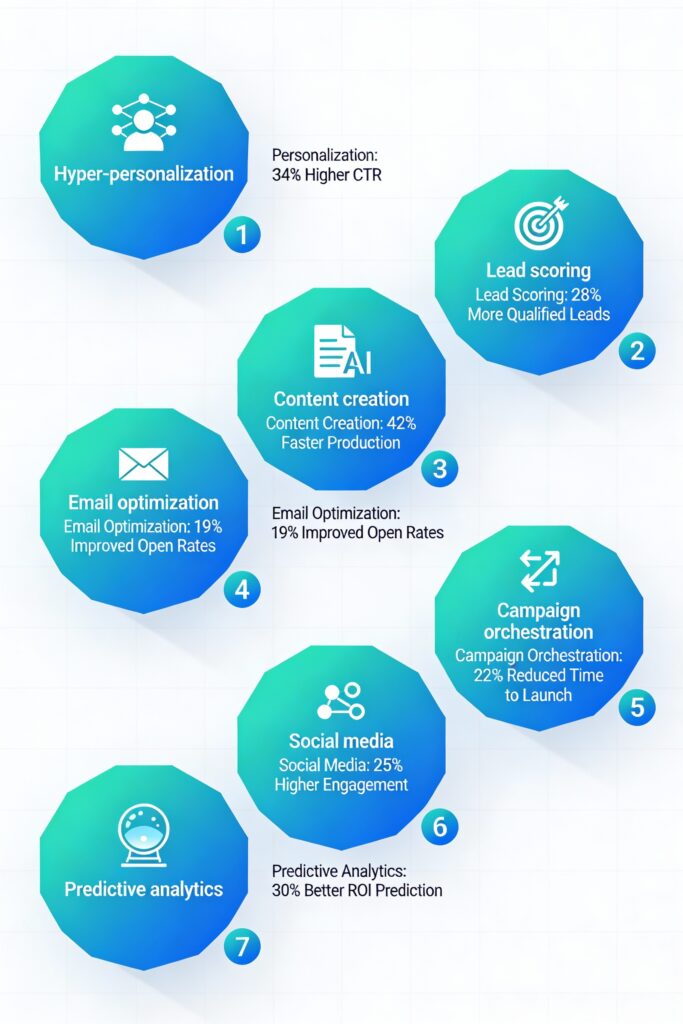
7 Core Use Cases of AI Marketing Automation
1. Hyper-Personalization at Scale
The Challenge: Traditional personalization requires manual segmentation. You might create 5-10 audience segments and personalize content for each. But your customers are individuals, not segments.
The AI Solution: Machine learning analyzes customer behavior patterns and automatically creates micro-segments—sometimes thousands of them—personalizing every element of the experience.
Real Example: An ecommerce brand uses AI personalization to customize:
- Homepage: Each visitor sees products based on their browsing history, purchase stage, and predicted preferences
-
Email Content: Subject lines, recommendations, and offers are personalized for each customer
-
Product Pages: Copy emphasizes different benefits depending on visitor type (price-sensitive vs. premium buyer)
Result: 34% increase in email click-through rates, 28% increase in conversion rates
Why It Matters: Customers feel understood. Personalized experiences increase engagement, repeat purchases, and customer lifetime value.
2. Predictive Lead Scoring & Qualification
The Challenge: Your sales team spends time on leads that never convert while hot prospects slip through the cracks. Determining who’s ready to buy is guesswork.
The AI Solution: Machine learning models analyze hundreds of data points to predict conversion probability for each lead—then automatically qualifies and routes them.
How It Works:
- Historical data feeds the model: Which leads converted? What did they have in common?
-
Real-time signals update scores: Page visits, email opens, content downloads, time spent on site
-
Predictive model identifies which leads are sales-ready (typically 20-40% higher conversion rate than traditionally qualified leads)
Result: Sales teams close 25-40% more deals, spend less time on unqualified leads
Why It Matters: Better lead quality means faster sales cycles, fewer wasted resources, and more predictable revenue.
3. AI-Powered Content Creation & Optimization
The Challenge: Content creation is slow and expensive. You need more content—blog posts, email variants, ad copy, landing page headlines—but your team is already stretched.
The AI Solution: AI writes, tests, and optimizes content at scale while humans handle strategy and review.
Practical Applications:
- Headline Generation: AI creates 50 headline variations for your blog post; you pick the 3 best
- Email Copy: Generate multiple versions of email body copy; AI predicts which will perform best
-
Ad Copy: Automatically create variations of ad creative optimized for different audiences
-
Blog Outlines: AI structures content based on keyword research and competitor analysis
-
Content Personalization: Each visitor sees unique copy tailored to their stage and interests
Real Example: A SaaS company uses AI copywriting to:
-
Generate 30 variations of landing page headlines
-
A/B test them automatically with traffic samples
-
Identify the highest-converting version in 48 hours instead of weeks
Result: 43% increase in landing page conversion rates
Why It Matters: You publish more content, faster, with data-driven optimization instead of guessing which version works best.
4. Intelligent Email Marketing (Send Times, Subject Lines, Content)
The Challenge: Sending emails at 9 AM doesn’t work for everyone. Some customers check email at night. Some open on mobile. One subject line won’t resonate with different segments.
The AI Solution: Machine learning optimizes every aspect of email campaigns in real-time.
What AI Email Automation Does:
-
Optimal Send Time: Analyzes each customer’s open patterns; sends to John at 8:47 AM and Sarah at 6:30 PM—when they’re most likely to open
-
Subject Line Optimization: Generates variations and predicts which will have highest open rate for each segment
-
Dynamic Content: Shows different product recommendations, offers, or messaging based on customer preferences
-
Unsubscribe Prediction: Identifies customers at risk of unsubscribing and adjusts frequency/content before they leave
-
Send Time Variation: Tests different send times and automatically applies what works
Real Example: An online retailer implemented AI email automation:
-
Open rate improved from 22% to 31% (42% increase)
-
Click-through rate improved from 3.1% to 4.7% (52% increase)
-
Revenue per email improved by 38%
Why It Matters: Email is still the highest-ROI marketing channel. Optimization here directly impacts revenue.
5. Dynamic Campaign Orchestration
The Challenge: Customers follow different paths to purchase. Your 3-email drip campaign works for some but drives others away. You’re not meeting customers where they are.
The AI Solution: Autonomous systems that orchestrate campaigns across channels, adjusting in real-time based on customer behavior.
How It Works: Customer A shows strong purchase intent → Campaign 1 (aggressive sales) Customer B is hesitant, needs education → Campaign 2 (content-focused nurture) Customer C is unresponsive to email → Campaign 3 (switch to SMS/ads)
The system makes these decisions automatically, continuously re-evaluating based on new signals.
Multi-Channel Orchestration:
-
Email sequences adjust based on opens/clicks
-
LinkedIn ads target engaged customers
-
SMS sends personalized reminders to mobile-first users
-
Retargeting ads appear to customers showing purchase intent
-
Conversation chatbots handle initial questions
All coordinated automatically. No conflicting messages. No redundant touchpoints.
Result: 60% reduction in unsubscribe rates, 40% increase in conversion rates
Why It Matters: Customers experience a cohesive journey, not a barrage of random messages. This builds trust and drives conversion.
6. Automated Social Media Management
The Challenge: Posting on social media is time-consuming. Your team spends hours on scheduling, monitoring, and engagement.
The AI Solution: AI handles posting, monitoring, and initial engagement—freeing your team for strategy and community building.
AI Social Automation:
-
Optimal Posting Times: Analyzes when your audience is most active; schedules posts for maximum reach
-
Content Recommendations: AI suggests which pieces of content to repurpose or which topics to focus on
-
Engagement Prioritization: Flags important comments/mentions for your team to respond to
-
Community Sentiment: Monitors brand mentions and automatically escalates negative feedback
-
Lead Qualification: Identifies interested followers and routes them to sales
-
Caption Generation: AI writes captions and hashtags based on image content
Result: 50% reduction in time spent on social, 35% increase in engagement rates
Why It Matters: Social media becomes manageable. Your team focuses on building community instead of administrative tasks.
7. Predictive Analytics & Customer Behavior Forecasting
The Challenge: You know what customers did. But what will they do next? Will they churn? What’s their lifetime value? When will they be ready to upgrade?
The AI Solution: Machine learning models predict future behavior with surprising accuracy.
Predictive Models in Action:
-
Churn Prediction: Identify customers likely to leave in next 30 days; intervene proactively
-
Lifetime Value Forecasting: Predict how much each customer will spend over their lifetime; prioritize high-value customers
-
Next Purchase Prediction: Forecast what customers will buy next and when; time offers perfectly
-
Upgrade Potential: Identify freemium users likely to convert to paid plans
-
Campaign Response: Predict which customers will respond to which offers before sending
Real Example: A subscription company uses churn prediction to:
-
Identify 500 at-risk customers each month
-
Send targeted retention campaigns
-
Reduce churn by 12% (protecting millions in annual revenue)
Why It Matters: Predictive insights let you act before customers leave, buy, or upgrade. You’re no longer reacting; you’re leading.
How AI Marketing Automation Works: The Technology Behind It
You don’t need to be a data scientist to use AI marketing automation. But understanding how it works helps you implement it effectively.
The Machine Learning Process (Simplified)
1. Data Collection The system ingests your data: customer interactions, email opens, clicks, purchases, browsing behavior, demographics.
2. Pattern Recognition Machine learning algorithms identify patterns: “Customers who view pricing pages + download case studies typically convert within 7 days.”
3. Model Training The algorithm learns from past behavior to predict future outcomes. Over time, it gets smarter.
4. Real-Time Application When new customers arrive, the trained model immediately applies its learning: “This person resembles past converters. Send them targeted content.”
5. Feedback Loop As new data comes in, the model re-evaluates: “That prediction was right/wrong. Let me adjust.” Continuous improvement.
Natural Language Processing (Writing & Copywriting AI)
This is what powers AI copywriting tools like Jasper and ChatGPT for marketing.
-
Input: “Write an email subject line for a SaaS product targeting busy marketing managers”
-
Processing: The AI model (trained on billions of words) understands context and generates relevant variations
-
Output: 10 subject line options, each optimized for different angles (pain relief, curiosity, benefit)
The AI doesn’t “understand” the way humans do. It recognizes patterns in language and predicts the next most likely word. Repeated millions of times, this produces surprisingly human-like text.
Why This Matters
AI makes marketing more efficient AND more effective. It automates the tedious stuff while enabling better strategy:
-
Humans: Set high-level strategy (“target marketing managers with cash flow problems”)
-
AI: Execute at scale (“show this message to 50,000 qualifying customers in personalized ways”)
-
Result: Better targeting, faster execution, happier teams
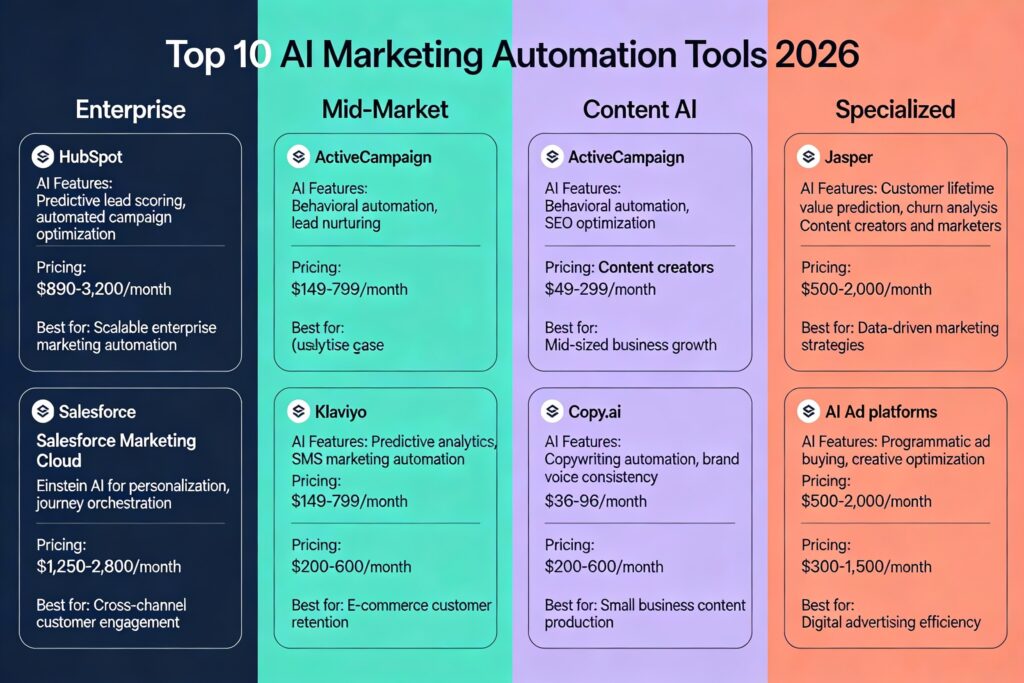
Top 10 AI Marketing Automation Tools in 2026
Enterprise Solutions
1. HubSpot Marketing Hub (with AI features)
-
Best For: All-in-one platform, SMEs to mid-market
-
AI Features: Predictive lead scoring, email send-time optimization, content recommendations
-
Pricing: $50-3,200+/month (depending on tier)
-
Standout: Most user-friendly AI features; strong free tier
2. Salesforce Marketing Cloud + Einstein
-
Best For: Large enterprises with complex sales processes
-
AI Features: Predictive analytics, lead scoring, journey optimization, content personalization
-
Pricing: $1,250+/month (enterprise pricing)
-
Standout: Deepest integration with Salesforce CRM; enterprise-grade
3. Adobe Experience Cloud (with Sensei AI)
-
Best For: Large enterprises, publishing companies
-
AI Features: Content personalization, predictive analytics, automated optimization
-
Pricing: $1,000+/month (enterprise pricing)
-
Standout: Strongest content personalization capabilities
Mid-Market Solutions
4. ActiveCampaign
-
Best For: Growing teams, SMEs to mid-market
-
AI Features: Predictive lead scoring, send-time optimization, content personalization
-
Pricing: $15-349/month
-
Standout: Best value for AI features at mid-market price point
5. Klaviyo
-
Best For: Ecommerce businesses
-
AI Features: Predictive sending, product recommendations, retention automation
-
Pricing: $20-1,450+/month
-
Standout: Best-in-class for ecommerce; exceptional for revenue optimization
6. Iterable
-
Best For: Growth-stage SaaS, mobile-first companies
-
AI Features: Multi-channel orchestration, send-time optimization, audience prediction
-
Pricing: Custom pricing (typically $500-5,000+/month)
-
Standout: Strongest multi-channel orchestration
Content & Copywriting AI
7. Jasper
-
Best For: Content teams, copywriters
-
AI Features: AI writing, content generation, brand voice preservation
-
Pricing: $39-125/month (usage-based)
-
Standout: Best for blog posts, ads, email copy
8. Copy.ai
-
Best For: Startups, agencies, freelancers
-
AI Features: Copy generation, SEO optimization, multi-language support
-
Pricing: Free-$49/month
-
Standout: Most affordable; best for experimentation
Specialized AI Tools
9. Predictive Analytics Platforms (e.g., Mixpanel, Amplitude)
-
Best For: Data-driven teams
-
AI Features: Behavioral prediction, retention analysis, funnel optimization
-
Pricing: $100-5,000+/month
-
Standout: Deepest behavioral analytics
10. AI Ad Platforms (Google AI, Meta Advantage+)
-
Best For: Paid advertising teams
-
AI Features: Automated bidding, creative optimization, audience targeting
-
Pricing: Built into ad spend
-
Standout: Most sophisticated ML algorithms; seamless integration
Step-by-Step Implementation Guide
Step 1: Audit Your Current Marketing Stack
Before implementing AI marketing automation, understand what you have:
Questions to Answer:
-
What marketing tools do you currently use? (Email, CRM, analytics, ads, social)
-
How much data do you collect? (Customer interactions, transactions, engagement)
-
What are your current bottlenecks? (What takes the most time/budget with lowest ROI)
-
What are your biggest opportunities? (Where could personalization help most)
Deliverable: Create a simple spreadsheet listing your tools, data sources, and integration points.
Step 2: Define Your Goals & Use Cases
Not all AI marketing automation is created equal. Focus on use cases that drive business impact.
High-Impact Use Cases (Start Here):
-
Email Send-Time Optimization (30% improvement in open rates)
-
Predictive Lead Scoring (40% improvement in conversion rates)
-
Product Recommendations (25% increase in average order value)
-
Churn Prediction (15% reduction in churn)
Lower-Impact Use Cases (Build Later):
-
Social media content scheduling
-
Generative email copy
-
Predictive subject lines
Set Clear Metrics:
-
Current state: “Our average email open rate is 22%”
-
Goal: “Increase to 30% in 90 days”
-
Success metric: “Email revenue increases by 35%”
Step 3: Select the Right Platform
Choose based on:
-
Your business type (ecommerce, SaaS, B2B, media)
-
Your current tools (will it integrate?)
-
Your budget (enterprise vs. startup pricing)
-
Your team’s technical level (simple vs. complex)
Decision Framework:
-
All-in-one solution needed? → HubSpot or ActiveCampaign
-
Ecommerce focus? → Klaviyo
-
Enterprise + Salesforce? → Salesforce Marketing Cloud
-
Content creation focus? → Jasper + your email platform
-
Multi-channel orchestration? → Iterable
Step 4: Integrate Your Data Sources
AI needs good data to work. Garbage in, garbage out.
Connect:
-
CRM (HubSpot, Salesforce, Pipedrive)
-
Email & messaging (Mailchimp, SendGrid)
-
Analytics (Google Analytics, Mixpanel, Amplitude)
-
Ads (Google Ads, Facebook Ads Manager)
-
Product/behavior (product database, event tracking)
-
E-commerce (Shopify, WooCommerce)
Clean Your Data:
-
Remove duplicates
-
Standardize data formats
-
Fill in missing fields where possible
-
Update historical data
Step 5: Build Your First AI Workflow
Start simple. Pick one use case.
Example: Predictive Lead Scoring
-
Define Conversion: “A lead converts when they purchase” (or request a demo, etc.)
-
Select Historical Data: Last 12 months of leads (minimum 100-200 conversions)
-
Choose Signals: Email opens, website visits, demo requests, pricing page views
-
Train the Model: The platform analyzes historical data and learns patterns
-
Apply to Current Leads: New leads automatically scored based on model
-
Action: Route high-scoring leads to sales immediately
Timeline: 2-4 weeks to train and deploy
Step 6: Train Your Team
AI isn’t magic. Your team needs to understand how to use it.
Training Topics:
-
What the AI does (and doesn’t do)
-
How to interpret AI predictions and recommendations
-
When to override AI recommendations (and when to trust it)
-
How to monitor performance and provide feedback
-
Privacy and compliance considerations
Ongoing Support:
-
Regular team meetings to review performance
-
Quarterly reviews of AI model accuracy
-
Annual audits of data quality and bias
Step 7: Measure & Optimize
Track whether your AI marketing automation is actually working.
Metrics to Monitor:
Monthly Review Process:”
-
Analyze performance metrics
-
Identify what’s working (do more of this)
-
Identify what’s not (adjust or replace)
-
Gather team feedback
-
Update models with new data
-
Test new use cases
Privacy, Consent & Compliance
AI marketing automation lives in a complex regulatory landscape. Handle it carefully.
The Privacy Shift
Before (Cookie-Based):
-
Tracked users across websites
-
Built profiles from third-party data
-
Personalized based on external signals
Now (Privacy-First):
-
Use first-party data (customers give directly)
-
Build profiles from owned interactions
-
Personalize based on direct customer signals
GDPR & CCPA Compliance
Key Requirements:
-
Transparency: Disclose how you use data and AI
-
Consent: Get explicit permission for personalization
-
Right to Explanation: Explain why AI made certain decisions
-
Data Minimization: Only collect data you need
-
Right to Deletion: Remove customer data on request
First-Party & Zero-Party Data
First-Party Data: You collect directly (email address, purchase history, website behavior)
Zero-Party Data: Customers voluntarily share (preferences, interests, survey responses)
Advantage: No compliance nightmares. Complete customer consent. Better for AI accuracy.
How to Collect:
-
Preference centers (“What topics interest you?”)
-
Surveys & questionnaires
-
Explicit consent forms
-
Customer feedback
-
Social listening (with disclosure)
Common Mistakes to Avoid
Mistake 1: Over-Automation Without Human Oversight
The Problem: Setting up AI workflows and forgetting about them. Algorithms can drift.
The Solution:
-
Review AI performance monthly
-
Set guardrails (e.g., “never send more than 2 emails per week”)
-
Have a human review important decisions
-
Maintain your brand voice and values
Mistake 2: Poor Data Quality
The Problem: AI learns from historical data. If your data is messy, predictions are useless.
The Solution:
-
Audit data before implementation
-
Remove duplicates and standardize formats
-
Fill in missing fields
-
Set up data validation rules going forward
Mistake 3: Ignoring Customer Privacy
The Problem: Over-personalization creeps customers out. Violating privacy regulations = fines.
The Solution:
-
Always get explicit consent
-
Be transparent about data use
-
Respect opt-outs immediately
-
Regularly audit for compliance
Mistake 4: Lack of Testing & Iteration
The Problem: Implement AI once and expect it to work forever. Customers change. Data drifts.
The Solution:
A/B test AI recommendations
Monthly performance reviews
Quarterly model retraining
Annual strategy audits
Mistake 5: Expecting Instant ROI
The Problem: AI marketing automation takes 3-6 months to show results.
The Solution:
Set realistic timelines (90+ days)
Measure incremental improvements
Focus on long-term value, not short-term wins
Be patient with model training
The Future of AI Marketing Automation (2026 & Beyond)
Emerging Trends 1.Fully Autonomous Marketing Systems By 2027, AI will handle strategy recommendation, not just execution. “Your customer segment is profitable; here’s my recommended strategy.”
2. Cross-Platform Integration AI that works across email, ads, social, SMS, and web—not separately, but as one coordinated system.
3. Real-Time Personalization Every touchpoint personalized to the individual, updated in milliseconds based on real-time signals.
4. AI-Generated Video & Audio Not just copy. Full video personalization at scale. “This customer gets a video where the CEO addresses them by name.”
5. Privacy-First AI Advanced techniques (federated learning, differential privacy) that enable AI without compromising individual privacy.